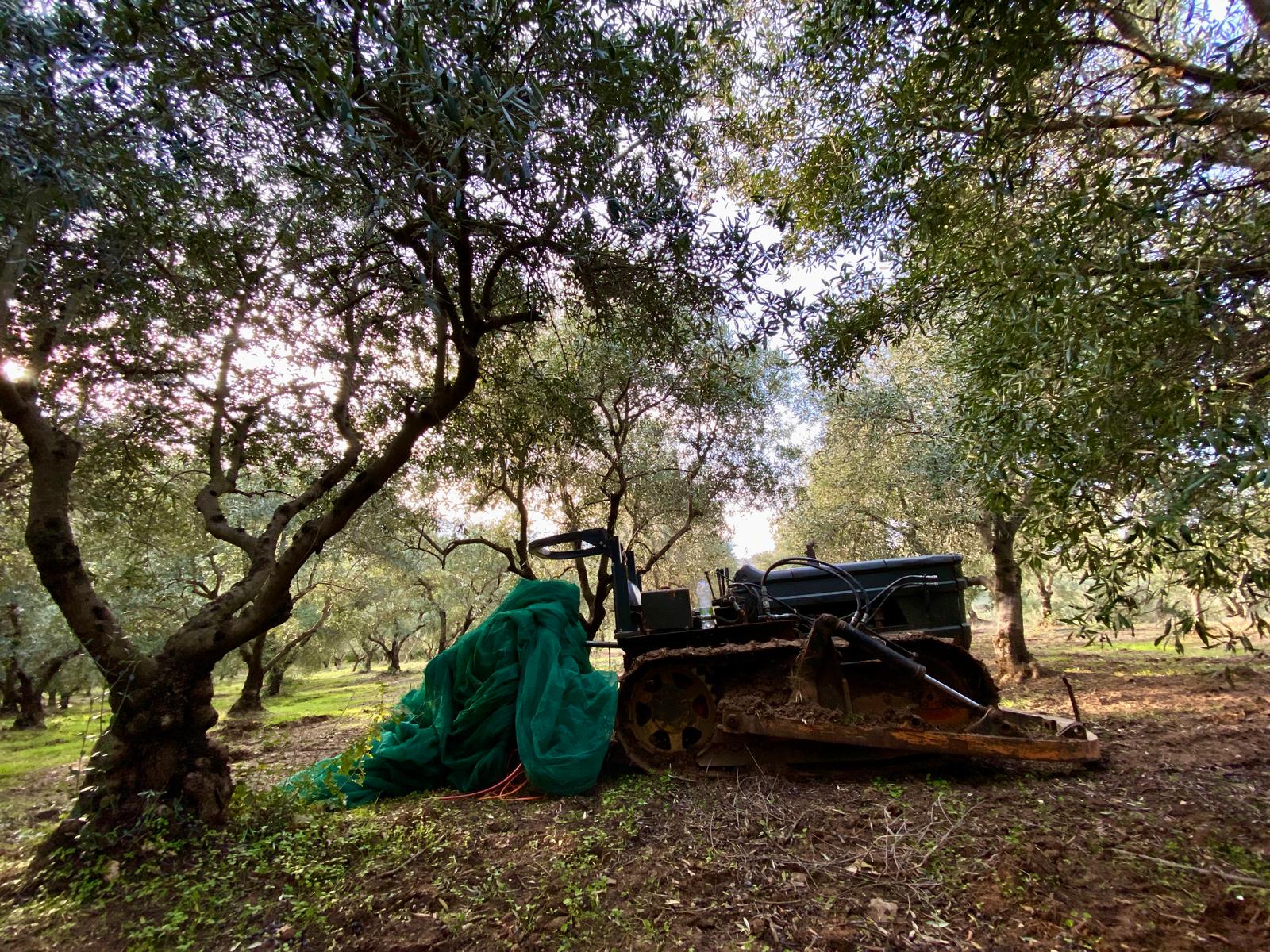
we do not own a mill. we take our olives to one we trust, a few minutes from the groves. that puts us on the customer's side of the counter rather than the owner's — and fifteen years as customers have taught us exactly where to look.
A mill is the plant that turns olives into oil. Put like that it sounds like a formality: fruit goes in, liquid comes out. In reality it is the point at which a perfect harvest can be ruined in an afternoon, and at which a mediocre one can no longer be saved by anything.
the five stages, in order
A modern mill runs a continuous cycle: olives go in at one end and oil comes out at the other without stopping. The route is always this.
- de-leafing and washing — leaves and twigs are drawn off and the olives rinsed in cold water. Leaves left in the mass give a green, disjointed bitterness, different from the good bitterness of the fruit.
- crushing — the olives, stones included, are broken into a paste. Hammer crushers are faster and generate more heat; disc crushers are slower and gentler.
- malaxation — the paste is stirred slowly so the droplets of oil merge into drops large enough to separate. This is the decisive stage, and I will come back to it.
- extraction in the decanter — a horizontal centrifuge separates by density: pomace on one side, liquid on the other.
- final separation — a centrifugal separator divides the oil from the vegetation water. What comes out is new oil: cloudy, and alive.
malaxation is the stage that decides everything
If I could watch only one gauge in the whole mill, it would be the thermometer on the malaxer. That is where the difference is made between an oil that lasts two years and one that is already flat by March.
Heating the paste suits the miller: warmer means more oil released, so a higher yield and more litres to sell. But heat carries off precisely the volatile molecules that make the aroma, and it speeds up the oxidation of the polyphenols, the antioxidants. Above a certain point you gain litres and lose oil.
The same applies to time. A long malaxation raises the yield but exposes the paste to air. Forty minutes at a low temperature gives less oil than ninety minutes at a high one — and an incomparably better oil.
"the miller earns on yield. you pay on quality. it is a structural conflict of interest, and it is worth knowing about."
"cold extracted" is not a slogan: it is a threshold
Two similar-looking phrases appear on bottles and they mean different things. Both are governed by the European rules on marketing standards for olive oil — delegated regulation (EU) 2022/2104, in force since November 2022.
- cold extracted: extraction by percolation or centrifugation at a temperature below 27 °C. This is the wording that belongs to modern plants.
- first cold pressing: also below 27 °C, but using the traditional hydraulic press system.
The useful consequence when you are buying: most mills today run continuous cycles and do not own a single press. If an industrial bottle says "first cold pressing", at best it is a phrase used out of habit. Both terms, moreover, are optional: they apply only to virgin and extra virgin oils and must hold true for the whole batch.
One last clarification that saves disappointment: cold does not mean good. It only means a temperature was not exceeded. Mediocre olives worked cold give a mediocre oil that simply was not heated.
continuous cycle or presses: which is better?
The honest answer is slightly deflating: there is no winner. Traditional presses, with their stacked mats, have a real romance to them and work without added water. But the mats are woven fabric that absorbs, and if they are not cleaned perfectly they hold residues that go rancid and pass the fault on to the next batches. That is why, among professionals, the continuous cycle has won almost everywhere.
A modern plant, kept clean and run at a low temperature, beats a press run carelessly almost every time. And the reverse. Who is operating it matters more than the machine.
the three points where a harvest gets ruined
1. the wait before milling
Olives piled in crates heat up by themselves and begin to ferment. Good practice says mill within 24 hours; we aim for four to six. This is why the distance to the mill genuinely matters, and is not a romantic detail for a website.
2. the temperature in the malaxer
Above 27 °C you leave the definition of cold extraction behind. But the difference is already in the nose between 24 and 27, and a miller in a hurry at the end of a long day tends to turn it up.
3. plant hygiene
A mill handles hundreds of batches in two months. Residues from the previous batch, if the plant is not washed down, end up in yours. Asking to be first in the morning, after the overnight clean, is not fussiness.
what we ask of our mill
We do not own a plant, so our only leverage is being demanding customers. In practice we ask three things: milling within a few hours of picking, a malaxer below 27 °C with the thermometer in view, and our batch run on its own — our olives not mixed with anyone else's.
That last point is the one most people never imagine. In village mills it is entirely normal for several families' olives to go into the same milling, with the oil then divided in proportion. It is convenient and cheap. But it means your quality becomes the average of everyone's quality. If you have picked by hand at the right moment, it is precisely what you do not want.
frequently asked questions
how long does it take to make oil at the mill?
From the moment the olives enter the hopper to the oil leaving the separator usually takes between 60 and 90 minutes. The longest stage is malaxation, 30 to 60 minutes. What matters more, though, is not that time but the time before it: the hours between picking and arriving at the mill.
how much oil do you get from 100 kg of olives?
Usually between 10 and 18 litres, a yield of 10% to 18%. It depends on the variety, the season, the rainfall and above all on ripeness: olives picked early give less oil but more polyphenols, ripe olives give more litres and less substance.
what is the difference between cold extracted and cold pressed?
Both indicate processing below 27 °C, but the method differs. "Cold extracted" refers to extraction by percolation or centrifugation, that is modern continuous-cycle plants. "First cold pressing" refers to the traditional hydraulic press system. Since almost no mill still uses presses, the second phrase on an industrial oil is often just a habit of language.
can you drink the oil straight from the mill?
Yes, and that is when it is at its most intense: cloudy, pungent, with the bitterness to the fore. Many find it almost aggressive. Over the following weeks the suspended particles settle and the profile rounds out. If the oil is left on its own deposit for too long, however, that deposit ferments and passes faults into the oil, which is why it has to be racked off after a few weeks.