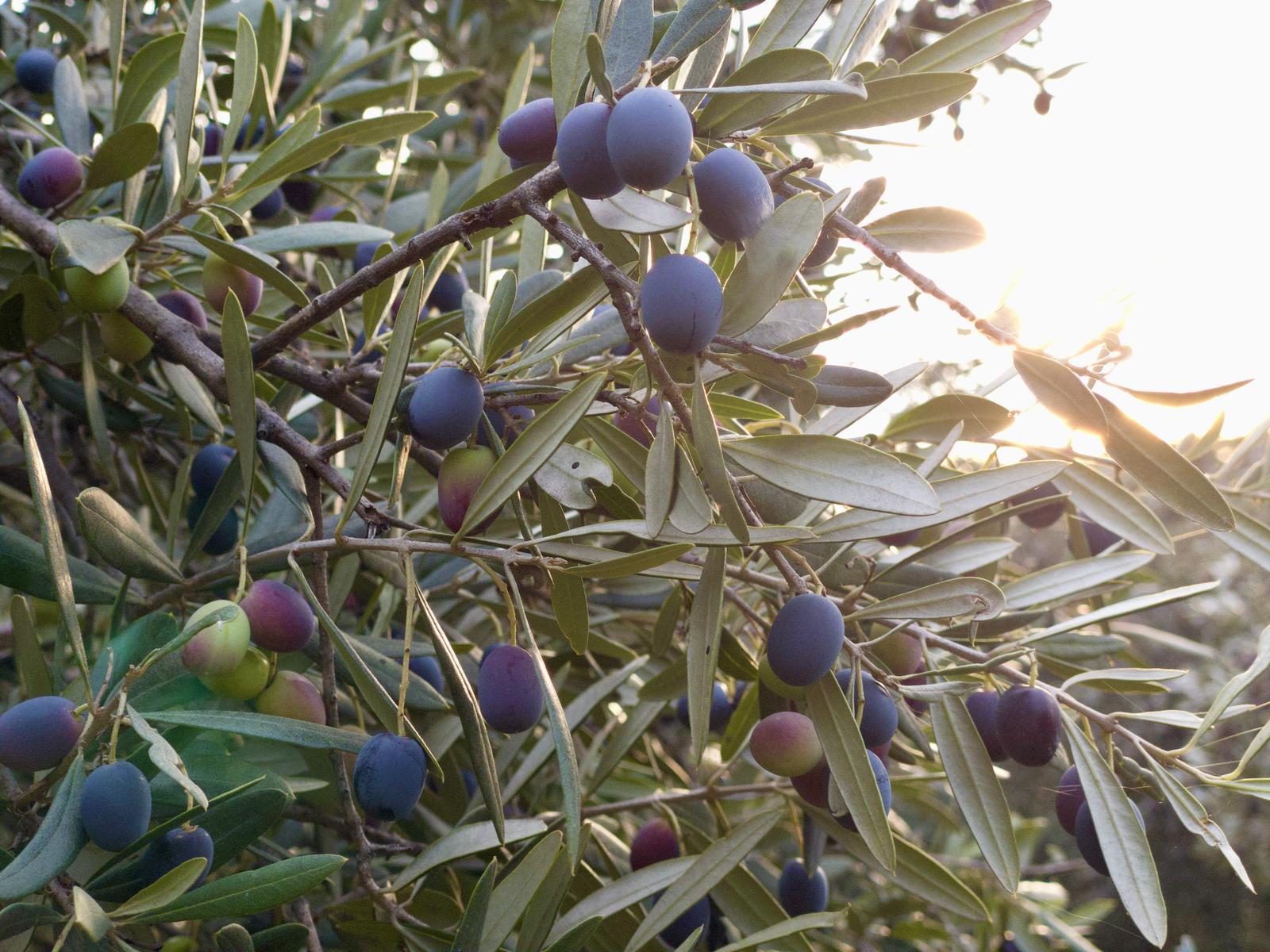
if you have ever drunk a Calabrian olive oil, in all likelihood you have drunk Carolea. it is the variety that took this region more than any other, and it has a rare quality: it makes a serious oil and, at the same time, a table olive people actually buy.
A cultivar is a cultivated variety of olive tree. Italy has more than five hundred catalogued, many of which live in a handful of villages and nowhere else on earth. It is the reason a Puglian oil and a Ligurian one taste of different things although both are extra virgin: the biggest single difference is not the soil, it is the tree.
In Calabria, the tree is Carolea.
what Carolea is
It is a dual-purpose variety: for oil and for the table. In the olive world that combination is uncommon, because the two destinations ask for opposite things. Oil wants fruit rich in fat and polyphenols; the table wants abundant, firm flesh that comes away cleanly from the stone and holds up in brine.
Carolea manages both. The fruit is large — four to seven grams, well above the average for an oil olive — with a favourable flesh-to-stone ratio. The tree is vigorous, hardy, long-lived, and tolerates the cold of the inland hills.
That is the other reason it spread. Calabria is not only coastline. In the hills above Cosenza, where our groves sit at Acri, winter is real. A delicate variety would not reach a hundred years there. Carolea does, and passes five hundred.
"a variety is not chosen by an agronomist. it is chosen by a century of winters, discarding whatever cannot take them."
how it tastes
The typical profile is medium fruity, with a sweet entry and a finish where bitterness and pepper make themselves felt without taking over. On the nose, tasters often note green tomato and artichoke, sometimes cut grass and almond.
It matters to say that this description is a starting point, not a guarantee. The same tree gives different oils depending on when you pick: Carolea taken at veraison — when the fruit turns from green to purple — is distinctly more bitter and pungent than the same Carolea picked three weeks later. Studies of Calabrian single-variety oils bear this out: the composition shifts with site and with the weather of the season.
So you will find producers describing it as delicate and others, ourselves among them, describing it as assertive. We are not contradicting one another. We pick at different moments.
Carolea and the Alto Crotonese PDO
The most formal recognition of its role is the Alto Crotonese protected designation of origin, whose rules require the olives to be at least 70% Carolea. When a variety enters a PDO specification with a minimum share that high, it means the identity of that oil is considered inseparable from that variety.
Our own groves are at Acri, in the province of Cosenza, and therefore outside that designation. We say so readily, because a PDO is a geographical boundary, not a report card: it tells you where you are, not how good you are.
Carolea, Coratina, Taggiasca: three ideas of oil
Comparison helps more than any description on its own.
- coratina (Puglia): the most powerful of the three. Strongly bitter and pungent, very high in polyphenols, extremely long-lived. It divides people: those unused to it find it difficult.
- taggiasca (Liguria): the opposite. Delicate, sweet, barely bitter, suited to anyone who wants an oil that does not cover the dish. It pays for that gentleness with lower resistance to oxidation.
- carolea (Calabria): in between, and that is not a polite way of saying bland. It has enough structure to stand up to a serious dish and enough balance not to bury a plate of boiled greens.
If that sounds like a comfortable position to occupy, it genuinely is: it is why Carolea is the easiest of the three to introduce to someone just beginning to tell olive oils apart.
how to recognise a real single-variety oil
"Monovarietal" means the oil comes from one variety only. It is not a protected legal category, so the word alone guarantees nothing. What you can check is something else.
- the harvest year on the label. If it is missing, you already have an answer about how transparent the producer is.
- the precise place, not the region. "Calabria" is a territory of a million and a half hectares; "Acri, province of Cosenza" is an address.
- consistency of profile: a declared single-variety oil that tastes of artichoke one year and sweet almond the next is probably not the same oil.
our Carolea
Our trees stand on the hills of Acri, some of them more than five hundred years old. We pick by hand, stripping the branches with our fingers, between veraison and full ripeness, and the olives reach the mill within hours. The result is a medium-intense fruitiness with bitterness and pepper present and recognisable.
It is not an oil built to please everyone at first taste. It is built to still be good in a year's time.
frequently asked questions
is Carolea an oil olive or a table olive?
Both. It is a dual-purpose variety, which is unusual: the fruit is large, with plenty of flesh relative to the stone, so it holds up in brine as a table olive, while also carrying enough fat and polyphenols for extra virgin oil production.
what is the main olive variety in Calabria?
Carolea. It is the prevailing variety across much of the region, above all in the provinces of Catanzaro and Crotone, and it is substantially present around Cosenza too. The Alto Crotonese PDO specification requires at least 70% of it.
what is the difference between Carolea and Coratina oil?
Coratina, from Puglia, is far more intense: markedly bitter and pungent, among the highest in polyphenols, very resistant to time. Carolea is more balanced, with a sweet entry and a bitter, peppery finish that is present but restrained. For a newcomer, Carolea is generally the more approachable.
how much olive oil does Calabria produce?
Calabria is consistently among the top two Italian regions for olive oil production, second to Puglia, with volumes that swing considerably from one season to the next. Unlike Puglia, though, a substantial share leaves the region unbottled and is bottled elsewhere: which is why a great deal of Calabrian oil is drunk without anyone knowing it.