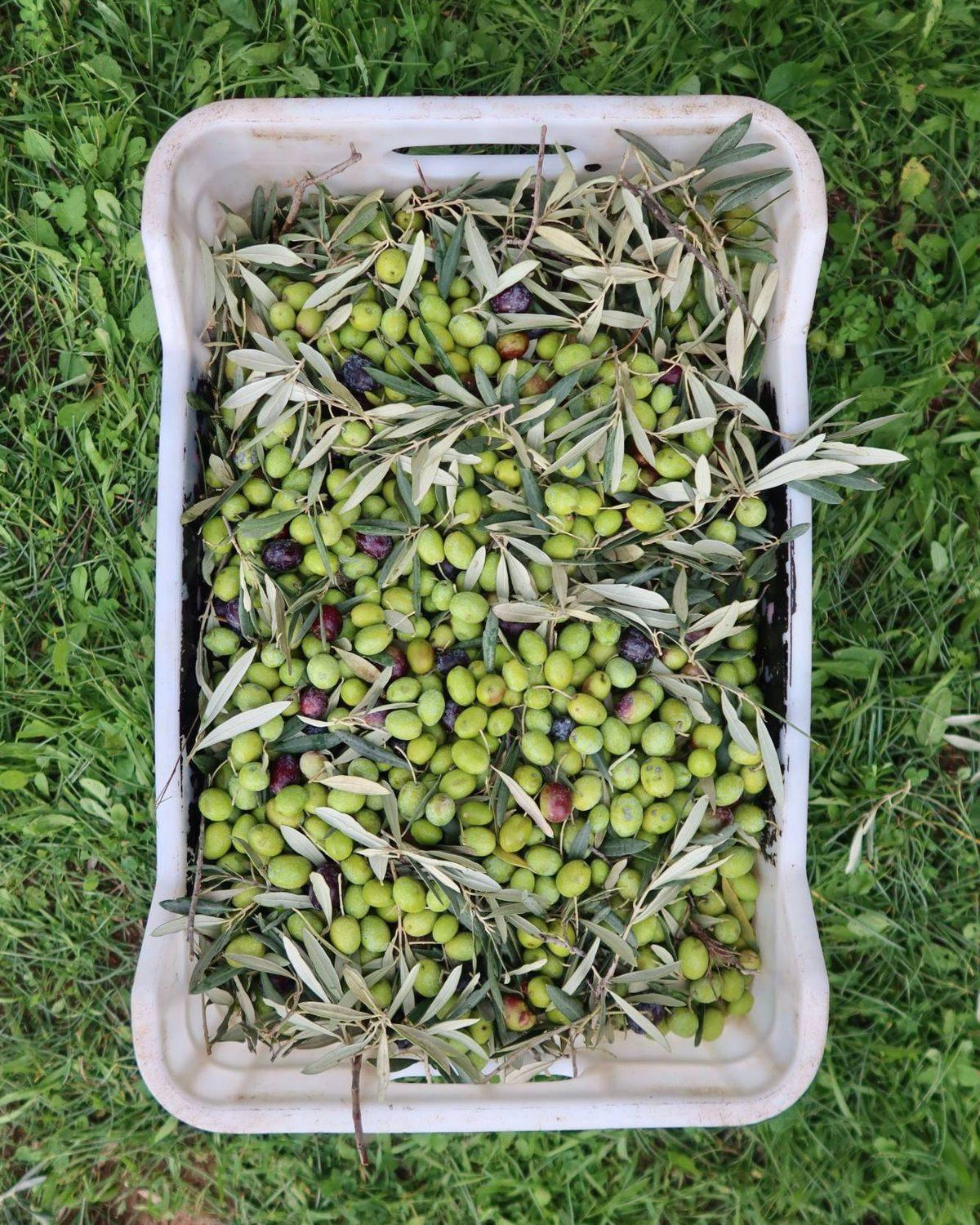
It usually takes between 5 and 9 kg of olives to make one litre of olive oil. Millers express this as the oil yield: the kilos of oil obtained from 100 kg of fresh olives. Tables from the University of California Cooperative Extension range from about 4% for watery table olives to 21% for very ripe oil varieties, and treat roughly 15% as a realistic expectation, which works out at a little over 6 kg of olives per litre.
How is olive oil yield calculated?
Weigh the olives going into the mill, weigh the oil coming out, divide the second number by the first and multiply by 100. That percentage is measured on the fresh weight of the fruit, water included.
The catch is that oil is weighed in kilos but sold in litres, and a litre of olive oil weighs less than a kilo. The Codex Alimentarius standard for olive oils gives a relative density of 0.910 to 0.916 at 20 °C, so one litre weighs about 0.91 kg. To turn kilos of oil into litres, divide by 0.91.
How many olives to make a litre of olive oil
These figures use a density of 0.913 kg per litre, the middle of the Codex range, and are rounded.
| Yield | Oil from 100 kg of olives | Litres from 100 kg | Kg of olives per litre |
|---|---|---|---|
| 10% | 10 kg | about 11 L | about 9.1 kg |
| 12% | 12 kg | about 13 L | about 7.6 kg |
| 15% | 15 kg | about 16.4 L | about 6.1 kg |
| 18% | 18 kg | about 19.7 L | about 5.1 kg |
| 20% | 20 kg | about 22 L | about 4.6 kg |
For a 5-litre tin, which holds about 4.6 kg of oil, that means anywhere from about 25 kg of olives (at 18%) to 46 kg (at 10%). At 15% it is around 30 kg, picked tree by tree. If you think in US units, Paul Vossen's guide puts a realistic figure at about 40 gallons of oil per short ton of fruit.
What decides how much oil you get from olives?
Vossen, a farm advisor with UC Cooperative Extension, splits the question into three parts:
- Oil content of the fruit. Partly genetic, so it depends on the variety, but it also shifts with the year, the tree's vigour, the size of the crop and ripeness. On a dry-weight basis it runs from under 10% to about 30%.
- Extractability. Some varieties release their oil easily; others hold it in an oil-and-water emulsion that is lost with the vegetation water or the pomace. Watery, over-irrigated fruit is the hardest to work.
- The milling process. How finely the paste is crushed, how long and how warm it is mixed (malaxation), and how efficient the decanter is. Our guide on how an olive mill works walks through each step.
Why is my olive oil yield low?
- The olives were picked green. Oil builds up in the fruit along an S-shaped curve. A University of Bari study on the Coratina variety in two areas of Apulia found the peak of oil accumulation in the first ten days of December. In Vossen's table, green, heavily watered Frantoio and Leccino give about 11%, ripe ones about 15%.
- The fruit is full of water. Yield is a share of fresh weight, so extra water dilutes it, and wet paste emulsifies. Rain just before harvest does this; the same varieties grown with deficit irrigation reach about 17%.
- The olives are overripe or damaged. According to the American Oil Chemists' Society (AOCS), overripe olives lose oil during washing.
- It is an "off" year. Olive trees bear alternately. Vossen notes that doubling the fruit usually adds only about 75% more oil, because a tree with fewer fruit and more leaves fills each olive better.
- The mill is protecting quality. The AOCS says yield rises with malaxation time and temperature, but advises keeping the paste below 30 °C: hotter paste changes the colour, raises acidity and loses aroma. Very fine crushing also extracts more, but makes a more bitter oil.
Olive oil yield by variety
Vossen's approximate table, built on Californian orchards, places the table olive Sevillano at the bottom (4% when green and over-watered) and very ripe, deficit-irrigated Picual and Mission at the top (21%). Frantoio and Leccino sit between 11% and 17% depending on ripeness and water. Ripeness also changes the taste: in the Coratina study, polyphenols, which bring bitterness and pungency, peaked in late September and early October and had roughly halved by mid-October. The authors placed the best harvest window for that variety in the second half of November. Southern Italian varieties such as Carolea have their own timing.
Yield at the mill versus oil content in the lab
Labs often report oil content on dry matter, after removing the water. That number is always higher than the mill yield, partly because water is excluded and partly because no mill extracts everything: the AOCS reports that pomace still holds 2.5 to 6% oil, which is later recovered with solvents to make olive pomace oil, never extra virgin. If someone says their olives "make 30%", ask whether that is fresh or dry weight.
We hand-pick our olives in Calabria and take them to a trusted mill within a few hours of harvest; you can read more on our home page or follow a tree through the season by adopting an olive tree. One practical tip for your own harvest: ask the miller for the result in kilos, not litres, and divide by 0.91 yourself. You will be comparing seasons on the same scale.
Frequently asked questions
How much olive oil do you get from 1 kg of olives?
Usually between 100 and 200 grams, which is a yield of 10 to 20%. At a typical 15% yield, 1 kg of olives gives about 150 g of oil, or roughly 0.16 litres.
How much olive oil from 100 kg of olives?
Between about 11 and 22 litres, depending on variety, ripeness and water content. UC Cooperative Extension treats roughly 15% as a realistic yield, which is about 16 litres.
How many olives does it take to make a bottle of olive oil?
For a 750 ml bottle, about 4.6 kg of olives at a 15% yield. The exact figure moves with ripeness and how wet the fruit is.
Why do green olives give less oil?
Oil keeps building up in the fruit as it ripens, so olives picked green still hold less of it. On the other hand, oil from greener olives is usually more bitter and pungent.
From our grove
Oil from the people who grow it.
Organic extra virgin olive oil from our groves in Acri, Calabria, hand-picked and milled within hours, in 5-litre tins.